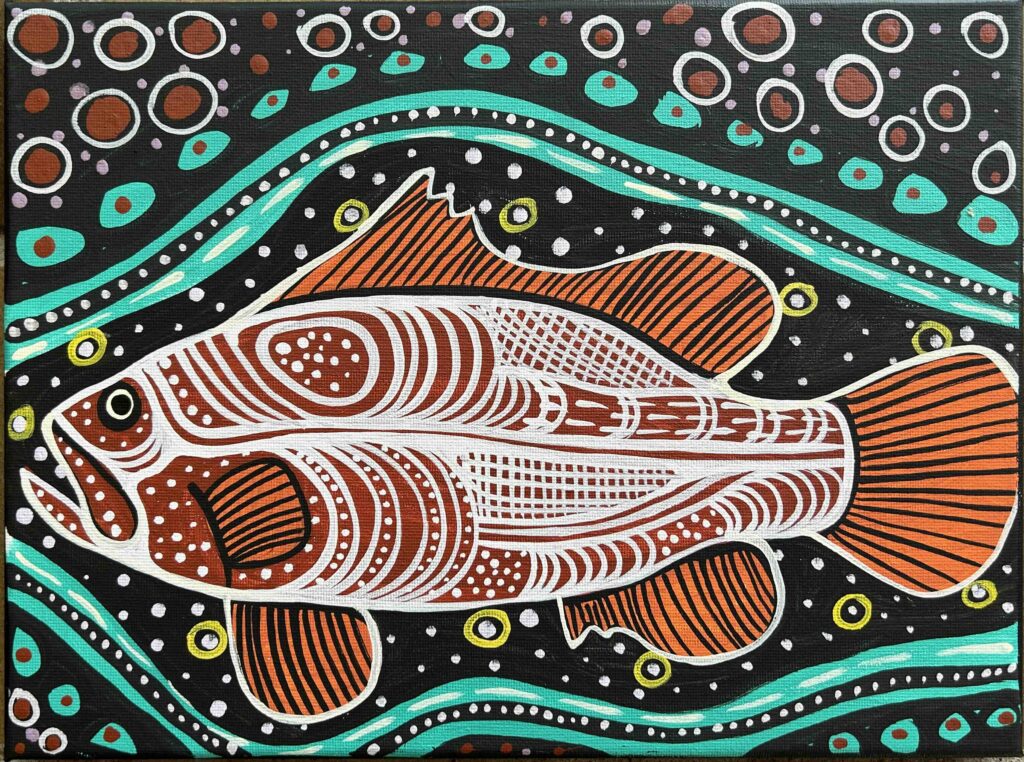
Kieren Karritpul – Barramundi 2026
- Size: 23 x 30.5 cm
- Medium: Acrylic on pre-stretched canvas
Ayalymerr
Aboriginal people in the Daly River region have a deep cultural and spiritual connection to barramundi, many viewing it as a sacred animal as well as a vital food source. The fish is central to local Indigenous culture, reflected in Dreaming stories, artwork, and traditional fishing practices. The river’s importance to Aboriginal people is long-standing, predating non-Indigenous settlement and continuing through traditional knowledge and contemporary practices. The emergence of dragonflies, is seen as a sign that barramundi season is approaching, indicating that it’s a good time to go fishing.
The Daly River region is a premier location for barramundi fishing for visitors, known for its abundance of the fish in both freshwater and tidal areas. The peak season is generally from April to June, particularly during the “runoff” period after the wet season, but fishing is productive year-round except during peak flood conditions.
Artist Bio – Kieren Karritpul
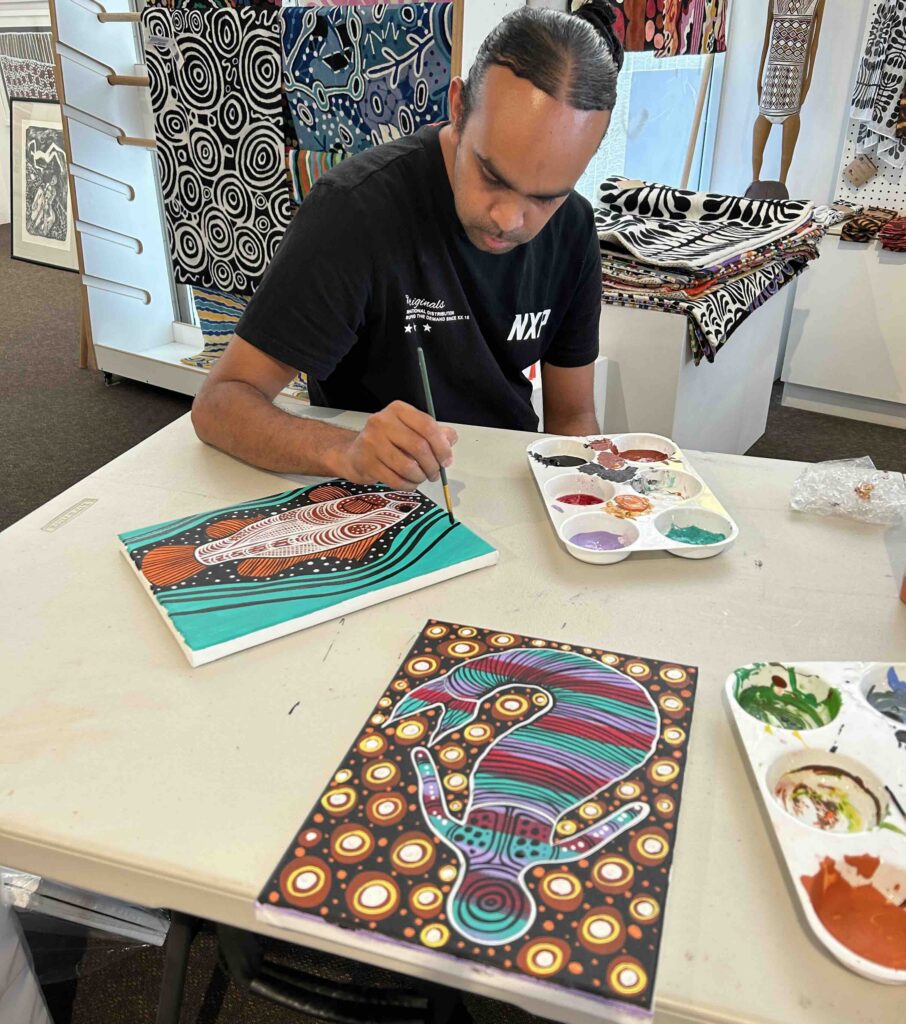
Kieren Karritpul is an outstanding and award winning artist who has work has been featured in solo exhibitions with Nomad (Darwin) and Tolarno Galleries (Melbourne) and group exhibitions around the world. His most recent solo exhibition was YERR WURRKEME MARRGU in May 2025 at Tolarno. See the exhibition here.
- Born 1994, lives and works in Nauiyu, Daly River, Northern Territory, Australia
- Traditional Country: Malfiyin
- Language: Ngen’gi wumirri
In Daly River artist Kieren Karritpul’s art there is no escaping the woven lines of inspiration. The woven form is both subject and metaphor in his work, and also to some extent part of their process. In his first solo exhibition, Karritypul, the titles of his paintings, prints and textile-based work all indicated a particular woven form including the yerggi which is actually a pre-woven form, yerrgi being the Daly River word (Ngan’gikurrungurr language) for the ubiquitous pandanus plant, the Screw Palm, Pandanus spiralis which together with the Sand Palm (merrepen, Livistona humilis) are the main sources of fibre for Top End weavers….
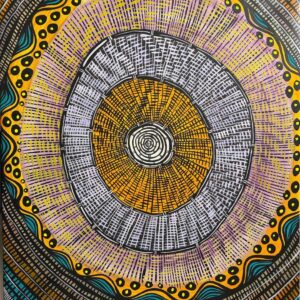
In these abstracted views, the woven form almost becomes mandala-like with the imagery built up from radiating bands of short parallel lines. In this sense the line can be seen as a faithful transposition of the coil weave technique rather than the traditionally longer, looser stitches though it is in effect more about Kieren’s visual-poetic licence in the process of translating one form into another to become something much more than what it represents; to transcend.
– Maurice O’Riordan, Director, Northern Centre for Contemporary Art, 2015 (Woven Lines catalogue essay excerpts)
$275.00